
Breakfast & Brunch
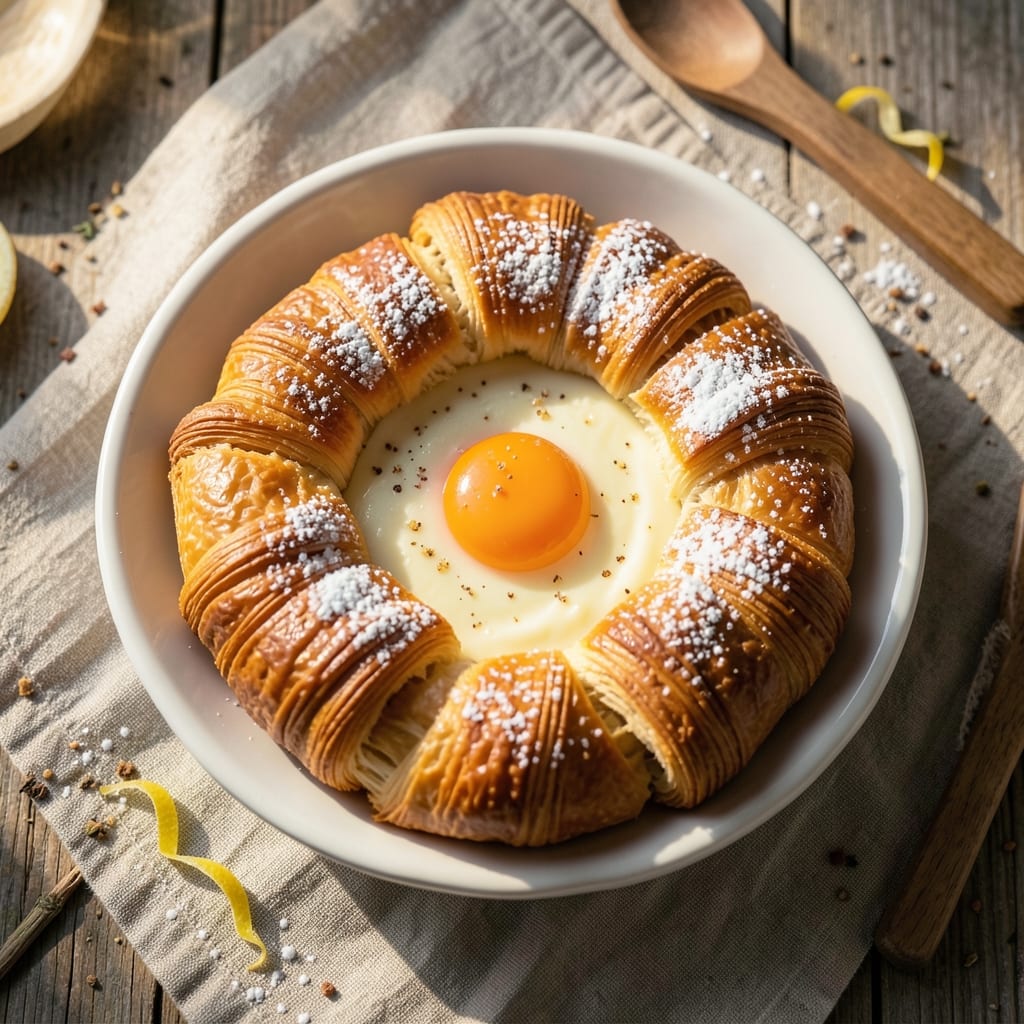
This croissant egg tart recipe delivers the perfect balance of flaky, buttery layers wrapped around silky custard centers—just like your favorite bakery. The secret lies in a properly blind-baked croissant base that stays crisp, while the custard achieves that signature silky, jiggly texture without curdling. I’ve perfected this technique after years of testing, ensuring every bite delivers that satisfying contrast of crisp and creamy.
The process starts with preparing the croissant base—whether store-bought or homemade—by blind-baking it to achieve that signature golden, crispy shell. Meanwhile, the custard filling, made with eggs, sugar, and flavorings like vanilla or lemon, must reach the ideal consistency: thick enough to hold its shape but light enough to stay tender. The assembly is simple but critical: pour the custard into the baked croissant cups and bake until set, resulting in a perfectly golden top with no soggy edges.
Once out of the oven, the contrast is undeniable: a crispy, flaky croissant shell encasing a silky, custardy center that’s just set. The result is a dish that’s elegant enough for brunch but simple enough for a weeknight treat. Garnish with a dusting of powdered sugar or fresh berries for an extra touch of sophistication.
This recipe is designed for foolproof results, whether you’re making a batch for a crowd or just a single serving. The techniques are straightforward, but the outcome is anything but basic—think bakery-quality without the fuss. Let’s get started on creating these irresistible egg tarts.
Ingredients for croissant egg tart
Eight simple ingredients transform into bakery-style croissant egg tarts with crisp shells and silky centers.
| Ingredient | Amount | Notes |
|---|---|---|
| Store-Bought Croissants 🥐 | 8 whole | Day-old preferred for crispness |
| Large Eggs 🥚 | 4 whole | Room temperature for even cooking |
| Granulated Sugar 🍚 | ½ cup | Superfine preferred for smooth custard |
| All-Purpose Flour 🌾 | 2 tbsp | For thickening custard base |
| Heavy Cream 🥛 | ½ cup | 35% fat for rich texture |
| Unsalted Butter 🧈 | 4 tbsp | Cold, cubed for blind baking |
| Pure Vanilla Extract 🌿 | 1 tsp | High-quality for authentic flavor |
| Lemon Zest 🍋 | 1 tsp | Freshly grated for bright flavor |
| Diamond Crystal Kosher Salt 🧂 | ¼ tsp | Fine grain for delicate seasoning |
| Powdered Sugar 🍚 | 2 tbsp | For final dusting |
| Fresh Berries 🍓 | ½ cup | Optional garnish, sliced |
The croissants are the foundation—day-old from Trader Joe's or local bakery work best for that perfect crispness. Avoid frozen croissants unless thawed completely, as moisture ruins the blind-baking process. For homemade croissants, use all-butter puff pastry for maximum flakiness. The eggs must be room temperature to prevent custard separation, so take them out 30 minutes before starting. Pillsbury Crescent Rolls can substitute in a pinch, but they yield a denser texture. The butter should be cold and cubed—never softened—for optimal blind-baking results.
No vanilla extract? Almond extract at half the amount works, though the flavor profile shifts. Substitute lemon zest with orange zest for a different citrus note, but reduce to 0.5 tsp to avoid overpowering. For a dairy-free custard, replace the heavy cream with full-fat coconut milk, though the texture will be slightly lighter. Superfine sugar dissolves more smoothly, but regular granulated sugar works if pulsed in a blender. The flour is purely for thickening—don't skip it, as it prevents curdling. If you prefer a sweeter custard, add 1 tbsp more sugar but reduce the cream by 2 tbsp to maintain balance.
Store-bought croissants keep 2-3 days in an airtight container at room temperature. Once assembled, refrigerate unbaked tarts for up to 12 hours—this enhances flavor development. Baked tarts stay fresh for 3 days covered at room temperature or 1 week refrigerated. For longer storage, freeze unbaked assembled tarts for up to 1 month—bake straight from frozen, adding 2-3 minutes to the baking time. Reheat in a 350°F oven for 5 minutes to restore crispness if serving cold tarts later.
Why You'll Love This Recipe
- Store-Bought Shortcut: I swear by this trick—no rolling dough, no waiting for puff pastry. Just slice those pre-made croissants, layer them in a pan, and you’re halfway there. Honestly, it’s the kind of recipe where the hardest part is deciding whether to use the buttery top or bottom layer.
- Creamy-Custard Magic: That heavy cream and egg combo? It turns into a velvety custard that’s dangerously good—like a cross between a French toast casserole and a breakfast tart. The sugar caramelizes just enough to give it a subtle sweetness that balances the richness perfectly.
- Breakfast or Brunch Hero: Serve it warm for a lazy weekend brunch, or pack the leftovers for a quick weekday breakfast. I’ve even used it as a base for a savory version (just swap sugar for cheese and herbs)—it’s that adaptable. My kids beg for it on school mornings, and my husband sneaks bites when he thinks I’m not looking.
- Zero-Waste Luxury: Between us, this recipe is my go-to for using up day-old croissants that’d otherwise go stale. The custard soaks up all that buttery goodness, and the leftovers? They reheat like a dream. Plus, it’s cheaper than buying pastries—same indulgence, fraction of the cost.
Step-by-step instructions for croissant egg tarts
Here's how to transform store-bought croissants into golden, flaky pastry shells cradling silky egg custards.
Prepare the Egg Custard Filling
In a medium bowl, whisk together the 4 whole large eggs until smooth and frothy. Add the 0.5 cup granulated sugar and continue whisking until fully combined and slightly thickened. This step ensures a perfectly smooth custard without lumps.
Next, incorporate the 0.5 cup heavy cream, 1 teaspoon pure vanilla extract, 1 teaspoon lemon zest, and 0.25 teaspoon diamond crystal kosher salt. Whisk vigorously for about 1 minute until the mixture is homogeneous and slightly mounded. The lemon zest adds a bright contrast to the rich custard, while the vanilla deepens the flavor profile.
In a separate small bowl, combine the 2 tablespoons all-purpose flour with 1 tablespoon cold water to create a thin slurry. Gradually whisk this into the egg mixture until fully incorporated. This prevents the custard from curdling when baked, ensuring a silky texture throughout.
Blind-Bake the Croissant Shells
Preheat your oven to 375°F. Line a baking sheet with parchment paper and arrange the 8 whole store-bought croissants in a single layer, slightly overlapping if needed. The day-old croissants will hold their shape better during baking.
Cut each croissant in half horizontally, creating two rectangular halves. Press the halves gently into the baking sheet to create shallow, even cups. This shape ensures the custard filling will sit perfectly in the center.
Place the 4 tablespoons cold unsalted butter, cut into small cubes, into the center of each croissant half. Bake for 8-10 minutes until the butter has melted and the croissants are lightly golden. Keep a close eye on them—they can go from perfect to overdone quickly.
Fill and Bake the Tarts
Remove the baking sheet from the oven and carefully pour the egg custard mixture into each croissant half, filling them about ¾ full. The custard should be level with the top edges of the croissants for even baking.
Return the tarts to the oven and bake for 15-18 minutes, until the custards are set but still slightly jiggly in the center. You want them to have that perfect custard texture—neither undercooked nor overbaked. The edges should be golden brown, indicating the croissants are fully baked.
During the last 2 minutes of baking, watch for the custards to puff slightly and then settle. This indicates they're reaching the ideal consistency. Remove from the oven and let cool for 5 minutes before serving.
Finish and Serve
While the tarts are still warm, dust the tops generously with the 2 tablespoons powdered sugar using a fine-mesh sieve. This creates a delicate, snowy finish that contrasts beautifully with the golden croissants and silky custard.
For presentation, arrange the 0.5 cup fresh berries on a platter and place the tarts alongside. The berries add a pop of color and freshness that complements the rich custard. Serve immediately while the croissants are still crisp and the custards are warm and silky.
These egg tarts are best enjoyed fresh from the oven, with the flaky croissant layers providing the perfect contrast to the creamy custard centers. The combination of textures and flavors makes each bite unforgettable.
Pro Tips For Making Croissant Egg Tart
- Preheat Pan Properly: The difference between a soggy bottom and a golden crust is a screaming-hot oven and a preheated pan. Place your baking sheet in the oven while it’s heating—yes, even if it’s just for 5 minutes—then add the croissants. Cold pans steal heat, and this isn’t a race.
- Whisk Eggs Until Ribbon-Stage: Thin, silky custard is the goal, not scrambled bits. Beat your eggs and cream until the mixture coats the whisk in a slow ribbon when you lift it—about 30 seconds past when it looks done. Overmixing? You’ll end up with a gluey mess. Under? Your tart will taste raw in the center.
- Slice Croissants Just Before Baking: That buttery, flaky magic starts degradating the second you cut. Wrap the whole package in a clean kitchen towel to keep them fresh, then slice them into triangles or rectangles right before assembling the tarts. Cold, straight-from-the-pack croissants hold their shape better too—no sad, greasy puddles.
- Bake in Two Stages: First, bake the croissants alone at 375°F (190°C) for 8–10 minutes until they’re just starting to turn golden. Then, pour in the custard and finish at 350°F (175°C) for another 12–15 minutes. This prevents the custard from curdling from the initial heat shock—trust me, your future self will notice the difference.
Troubleshooting perfect results
Custard Curdling
The most common issue is custard that separates or curdles during baking. This happens when the eggs cook too quickly or the mixture isn't properly tempered. To prevent it, always whisk the eggs and sugar together first until slightly thickened—this stabilizes the proteins. Then gradually add the cold cream and whisk vigorously for 1 full minute to fully emulsify. I've found that using room-temperature eggs (not cold) also helps prevent curdling. If your custard still separates, whisk in 1 extra tablespoon of flour slurry before baking. 💡
Soggy Croissant Shells
If your croissant shells lose their crispness and become soggy, it's usually from steam during baking. The solution is to ensure proper blind-baking: place the croissants on a baking sheet lined with parchment paper and bake until the butter melts and the shells are lightly golden. Then, let them cool completely before adding the custard. I recommend baking the custard-filled tarts at 350°F instead of 375°F to reduce steam buildup. Another trick is to chill the custard mixture for 10 minutes before pouring it into the shells—this helps set it faster and prevents moisture transfer. ❄️
Uneven Baking
When the custard centers remain undercooked while the edges overbake, it's usually because the oven temperature fluctuates or the tarts aren't filled evenly. Use an oven thermometer to confirm your oven is at the correct temperature—many home ovens run 25-50°F hotter than set. Also, ensure your custard is poured to the same level in each croissant half. For extra insurance, bake the tarts on the middle rack where heat is most even. If you notice uneven browning, rotate the baking sheet halfway through baking. 🔥
Cracked Custard Tops
Cracks in the custard surface often occur when the tarts bake too long or the custard is overfilled. To avoid this, fill the croissant shells only ¾ full with custard and remove the tarts from the oven as soon as the centers are just set (they'll continue cooking slightly after removal). If you prefer a smoother finish, dust the custard with 1-2 teaspoons of powdered sugar before baking—this creates a protective layer that prevents cracking. I've also had success gently tapping the baking sheet on the countertop right after removing the tarts from the oven to release any trapped steam. ✨
Butter Not Melting
If the butter in your croissant shells doesn't melt during the blind-baking stage, it's likely because the oven temperature isn't high enough or the butter cubes are too large. Preheat your oven to 375°F and use small, ½-inch cubes of butter. Place the baking sheet on the upper-middle rack where it's hottest. If your oven runs cool, increase the temperature by 25°F and check the butter after 6 minutes. Never skip this step—properly melted butter creates that signature flaky, buttery flavor in the croissant shells. 🧈
Filling Spills Over
When custard overflows during baking, it's usually because the croissant shells weren't pressed deep enough or the custard was poured too high. To fix this, press each croissant half firmly into the baking sheet to create deeper cups before adding butter. Also, use a spoon to level the custard mixture exactly at the top edge of each shell—no higher. For extra insurance, chill the custard mixture for 10 minutes before pouring to help it set faster. If you do get overflow, use a small offset spatula to carefully scrape excess custard off the baking sheet before serving. 🍴
Nutrition facts
Frequently asked questions
Can I make these egg tarts with puff pastry instead of croissants?
Puff pastry works beautifully and gives a slightly different texture—more delicate and crisp. Use 1 sheet of thawed puff pastry (about 1/8-inch thick) and cut it into 8 equal rectangles. Press them into the baking sheet like croissants, then follow the same blind-baking steps. The custard will set perfectly in the flaky layers, creating a lighter version of the classic tart.
Why does my custard sometimes look grainy or separate?
Grainy custard usually means the eggs weren't properly whisked with sugar first, or the cream was added too quickly. Always whisk the eggs and sugar together until slightly thickened (about 1 minute) to stabilize the proteins. Then gradually whisk in the cold cream. For extra insurance, strain the mixture through a fine-mesh sieve before pouring into the shells. This removes any tiny lumps that could cause texture issues.
How can I make these egg tarts ahead of time?
You can prepare them up to 24 hours ahead! Assemble the tarts (with custard) and refrigerate unbaked for up to 12 hours—this actually enhances the flavor. For baked tarts, let them cool completely, then store in an airtight container at room temperature for 3 days or refrigerate for 1 week. To refresh crispness, warm them in a 350°F oven for 5 minutes before serving. For longer storage, freeze unbaked assembled tarts for 1 month—bake straight from frozen, adding 2-3 extra minutes.
What's the best way to store leftover custard mixture?
Store any unused custard in an airtight container in the refrigerator for up to 3 days. Before using, whisk it vigorously to restore smoothness—it may thicken slightly. For longer storage, transfer to a freezer-safe container and freeze for up to 1 month. Thaw overnight in the fridge, then whisk again before pouring into shells. Never refreeze custard after thawing, as it can develop a grainy texture.
Can I use a different flavor custard instead of vanilla-lemon?
Try chocolate by replacing the lemon zest with 2 tablespoons cocoa powder and adding 1 teaspoon instant espresso powder for depth. For caramel, swap the vanilla with 1 teaspoon caramel extract and add 1 tablespoon brown sugar to the custard. Matcha lovers can replace vanilla with 1 teaspoon matcha powder and use 1/4 cup almond milk instead of cream. Just